
O Seedance é o modelo de vídeo da ByteDance. A versão 2.5 faz clipes de até 30 segundos com cortes, diálogo e som próprios (o guia de prompts do Seedance 2.5 no BytePlus, a nuvem da ByteDance, em inglês), e isso muda a forma de trabalhar com ele. Pedir um plano de cada vez e depois brigar para os clipes combinarem é lento e perde a atuação entre eles. A unidade melhor é a cena: um único pedido que contém a preparação, a resposta e o desfecho, com todos os cortes escritos. Cada cena abaixo é uma única geração do Seedance 2.5 feita pelo agente do Bald Rhino. A trilha sob a imagem mostra os planos, cada um com a duração que o prompt pediu, e o prompt ao lado marca o plano que está tocando. Os prompts aparecem como foram enviados, em inglês.
Documentário de natureza · 4 planos · 2 referências
Plano 1 · 0:00
A 24-second photorealistic nature-documentary scene in a misty Late Cretaceous forest. @Image 1 sets the place, framing and light: a low view at a small child's eye height, hidden behind big fern fronds, a small muddy puddle in the foreground, a path between tall conifer trunks beyond. @Image 2 sets the Tyrannosaurus rex's exact appearance: massive skull, lips covering most of the teeth, tiny two-fingered arms, horizontal body balanced by a long thick tail, dark brown and olive skin. Shot 1, 0-8s: static low view as in @Image 1. Quiet forest. A deep distant THUD: concentric ripples spread across the puddle surface. A second, stronger THUD: bigger ripples, the ferns tremble. Shot 2, 8-15s: the T. rex steps into view from the misty path far beyond the puddle, walking slowly between the trunks. It stops, lifts its head and sniffs the air. Shot 3, 15-19s: it raises its head toward the sky, turned to the side and away from the camera, and lets out a deep powerful roar; small birds flutter out of the trees. Shot 4, 19-24s: it turns and walks away deeper into the mist; its footsteps fade and the puddle slowly settles. Exciting but safe for a young child: it never notices or approaches the camera, no attack, no chasing, no blood. Sound: heavy footstep thuds, water rippling, a deep rumbling roar, wings fluttering, then quiet forest ambience. No music, no speech, no text, no people.
-
Documentário de natureza · 4 planos · 2 referências
Cretáceo Superior
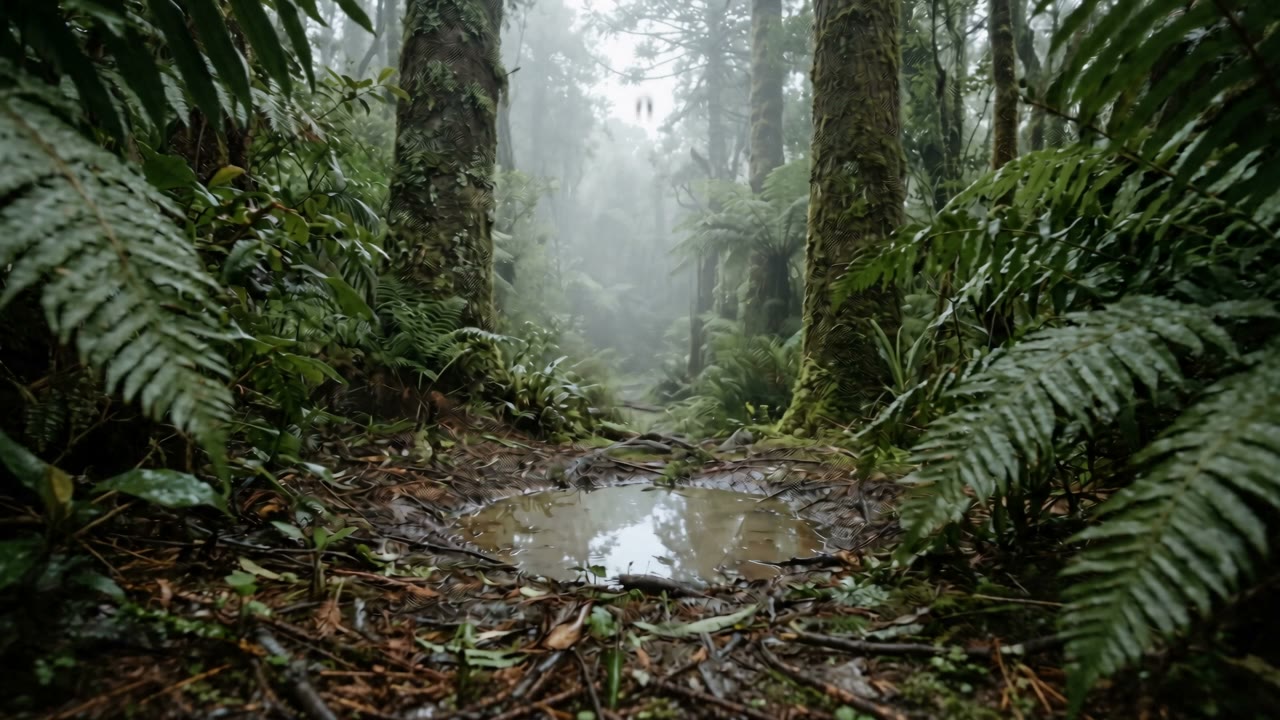
A 24-second photorealistic nature-documentary scene in a misty Late Cretaceous forest. @Image 1 sets the place, framing and light: a low view at a small child's eye height, hidden behind big fern fronds, a small muddy puddle in the foreground, a path between tall conifer trunks beyond. @Image 2 sets the Tyrannosaurus rex's exact appearance: massive skull, lips covering most of the teeth, tiny two-fingered arms, horizontal body balanced by a long thick tail, dark brown and olive skin. Shot 1, 0-8s: static low view as in @Image 1. Quiet forest. A deep distant THUD: concentric ripples spread across the puddle surface. A second, stronger THUD: bigger ripples, the ferns tremble. Shot 2, 8-15s: the T. rex steps into view from the misty path far beyond the puddle, walking slowly between the trunks. It stops, lifts its head and sniffs the air. Shot 3, 15-19s: it raises its head toward the sky, turned to the side and away from the camera, and lets out a deep powerful roar; small birds flutter out of the trees. Shot 4, 19-24s: it turns and walks away deeper into the mist; its footsteps fade and the puddle slowly settles. Exciting but safe for a young child: it never notices or approaches the camera, no attack, no chasing, no blood. Sound: heavy footstep thuds, water rippling, a deep rumbling roar, wings fluttering, then quiet forest ambience. No music, no speech, no text, no people.
-
Comédia animada · 8 planos · 1 referência
A estufa com goteira
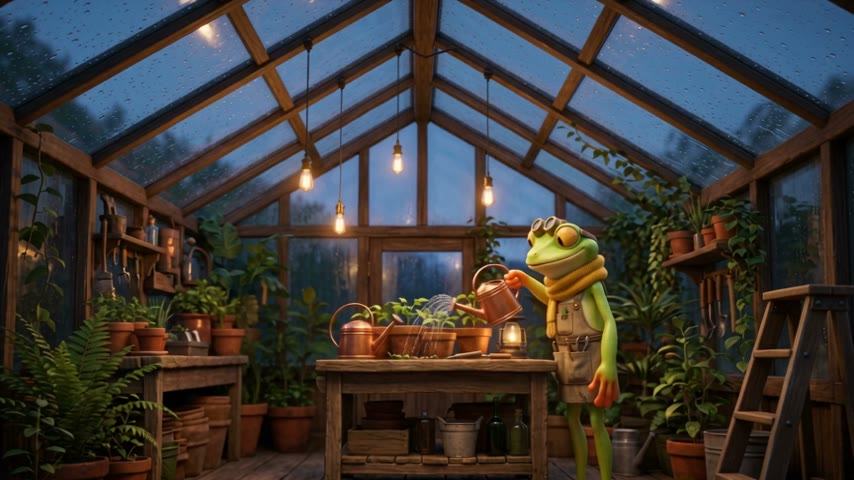
Audio policy (all shots): the two characters' spoken lines, the marked sound effects and steady rain on the glass roof, plus the one light music theme marked below. No subtitles. A continuous comedy scene in one location, a rainy greenhouse workshop at dusk, in eight shots, 3D animated feature-film style. @Image 1 is the character-and-location sheet: take the two characters' designs and the greenhouse workshop from it, and take nothing else from it. On the left of @Image 1, Bolt: a small round teal tin robot with one large round cyan eye-lens, two thin antennae with red bulb tips, stubby clamp hands, rolling on a single black rubber wheel. On the right of @Image 1, Fern: a tall slender lime-green tree frog standing upright, with big golden eyes, a mustard-yellow knitted scarf, a canvas work apron and brass goggles pushed up on her forehead. The workshop: a peaked glass roof, a long wooden workbench with a row of seedlings in clay pots, warm hanging bulbs, a wooden stepladder on the right, cool blue dusk light through the glass and warm amber light inside. Music: (a light, playful pizzicato strings theme, steady medium tempo, quiet under the voices, 0-30s). Shot 1, 0-3s: wide shot of the workshop, static camera. Fern, the tall green frog in the yellow scarf, stands at the workbench on the right, watering the seedlings. A drop of water falls from a crack in the glass roof onto a seedling. <rain patters on the glass roof> <a single drip taps a clay pot> Shot 2, 3-6s: medium close-up of Fern, slight low angle. She looks up at the roof, eyes wide, and calls out. Fern, the tall green frog (a warm, quick, mid-range female voice): "Bolt! The roof is leaking on my seedlings!" Shot 3, 6-10s: medium shot, the camera tracking left to right. Bolt, the small teal robot with the cyan eye, rolls in fast from the left carrying a dented tin bucket over his head and sets it under the drip. Bolt, the small teal robot (a bright, small, slightly tinny boyish voice): "Bucket deployed!" <wheel squeak> <a drip plinks into the metal bucket> Shot 4, 10-13s: the same medium shot continues without a cut: Bolt, beside the bucket, looks up as a second and then a third drip start falling beside the first onto the bench. <drips tapping wood> Shot 5, 13-17s: two-shot at bench height, Bolt on the left and Fern on the right. Bolt's eye-lens flicks between the three drips; he holds up his one bucket. Bolt, the small teal robot (a bright, small, slightly tinny boyish voice): "Three leaks. One bucket." Fern grabs a roll of silver tape from the bench. Shot 6, 17-20s: medium shot. Fern climbs the wooden stepladder on the right, tape in hand, while Bolt rolls over and grips the ladder's legs with both clamp hands. Fern, the tall green frog (a warm, quick, mid-range female voice): "Hold the ladder steady!" <ladder creaks> Shot 7, 20-25s: the ladder shot continues without a cut, then the camera tilts up to a low angle past Bolt's antennae. At the top of the ladder, Fern tears a strip of tape and presses it over the crack; the ladder wobbles and Bolt braces it, his wheel skidding. <tape tearing> <ladder rattles> Fern (warm female voice): "Got it!" Shot 8, 25-30s: close-up of Bolt, the small teal robot, looking up proudly. One last drop falls and lands right on his cyan eye-lens; his lens shutter blinks twice. Bolt, the small teal robot (a bright, small, slightly tinny boyish voice), deadpan: "Except this one." Fern, the frog above, laughs softly off-screen. <a drip taps metal> <soft rain continues> Keep the characters' designs, sizes and screen sides consistent in every shot: Bolt reaches about Fern's hip; Bolt on the left, Fern on the right unless a shot says otherwise. The light stays cool blue dusk outside and warm amber inside throughout. Sound: only the two voices, the marked effects, steady rain on the glass and the one pizzicato theme. No subtitles, no text or logos.
-
Desenho 2D · 7 planos · sem referências
Pastelão na lanchonete
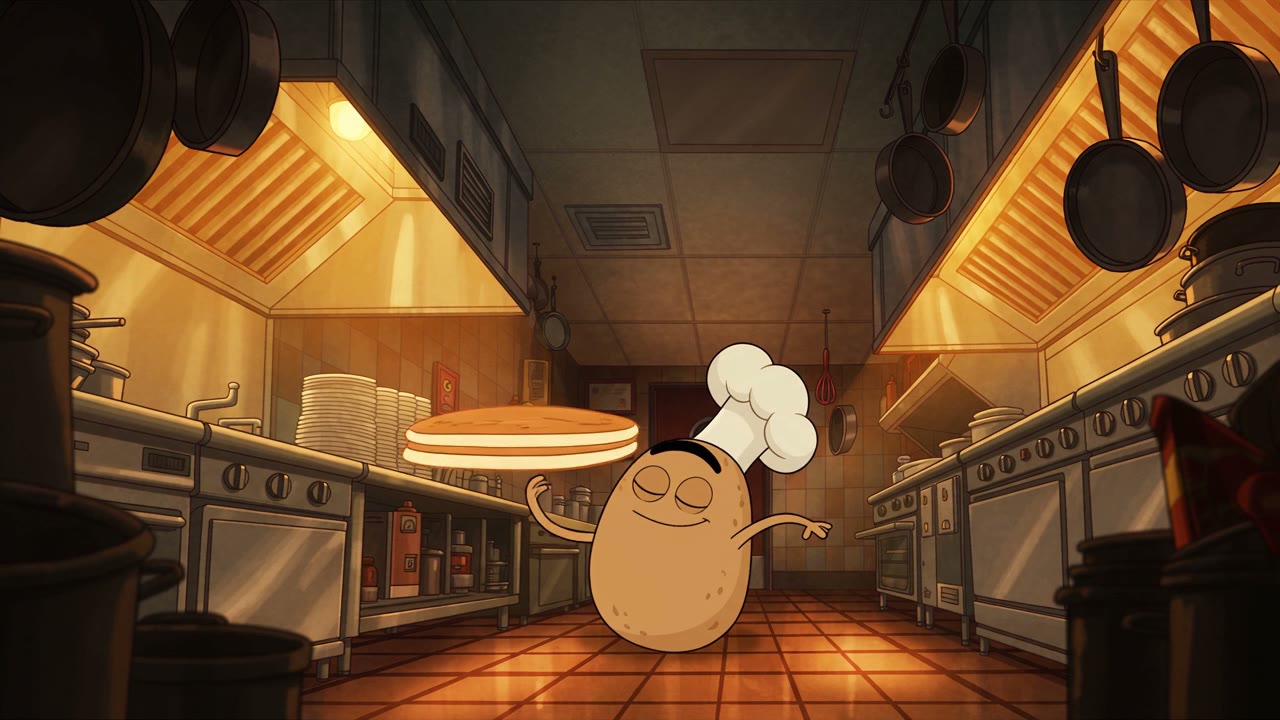
Bright, hyper-exaggerated 2D cartoon in the style of a zany Saturday-morning slapstick show: thick wobbly outlines, saturated colours, squash-and-stretch animation, rubbery limbs, huge bulging eyes. One location: a cramped, chaotic neon-lit diner kitchen with a pass-through window to the counter. Recurring cast: CHEF SPUD, a short round potato in a tall crooked chef hat with one giant unibrow and tiny arms; MORTIMER, a very tall noodle-limbed pelican waiter with a bow tie, whose beak holds a whole tray of plates; and GRUMBLE, a tiny furious lemon customer with a monocle and a huge moustache who sits on a stack of cushions at the counter. 0-4s: Shot 1, wide establishing shot of the kitchen. Chef Spud proudly flips a pancake; it sails up and sticks to the ceiling. Spud's eyes bulge to the size of dinner plates and his jaw drops to the floor with a cartoon boing. <boing, record scratch> Spud: "Nobody. Move." 4-8s: Shot 2, quick close-up on Grumble the lemon, veins popping, face turning from yellow to red, steam whistling out of his ears like a kettle. Grumble screams in a squeaky voice: "WHERE IS MY SOUP?!" His monocle pops out and spins in the air. 8-13s: Shot 3, medium shot. Mortimer the pelican stretches his neck like an accordion down the length of the kitchen, balancing a tower of twenty bowls on his beak, wobbling in a slow, panicked dance. His eyes go cross-eyed, pupils spiralling. <comic xylophone wobble> 13-18s: Shot 4, low angle whip-pan. Mortimer slips on the pancake batter, flips into a full slow-motion somersault, bowls spinning like planets around him, while Spud dives in a heroic pose and catches every bowl on his head, stacked in a perfect tower. Spud's face: smug, sweating, eyebrow wiggling. <cymbal crash> 18-23s: Shot 5, close-up on the counter window. Spud slides the tower over; Grumble peers into a bowl and finds it full of tiny googly-eyed noodles that wave at him. Grumble's face stretches comically long, eyes popping out on springs. The noodles chirp: "Hiiii!" 23-27s: Shot 6, wide shot. Grumble, trembling with fury, inhales hugely, swelling like a balloon, then burps a giant green bubble that floats up, engulfs Mortimer and Spud, and carries them out through the ceiling vent like a parade float. The ceiling pancake falls on Grumble's head like a hat. 27-30s: Shot 7, static medium shot on Grumble alone, pancake on his head, deadpan, one eyebrow raised, slowly sipping a tiny cup of tea. He says flatly: "...Needs salt." <single tiny sad trombone note> Hold the final frame. Lighting: warm, punchy diner neon, soft bounce. Camera: snappy cuts, exaggerated whip-pans, dramatic push-ins on faces. Sound: zany cartoon sound effects, boings, slide whistles, squeaky voices, no background music. Clean picture without subtitles, captions, text, logos or watermarks.
-
Drama · 3 planos em 8 segundos
Chuva no para-brisa
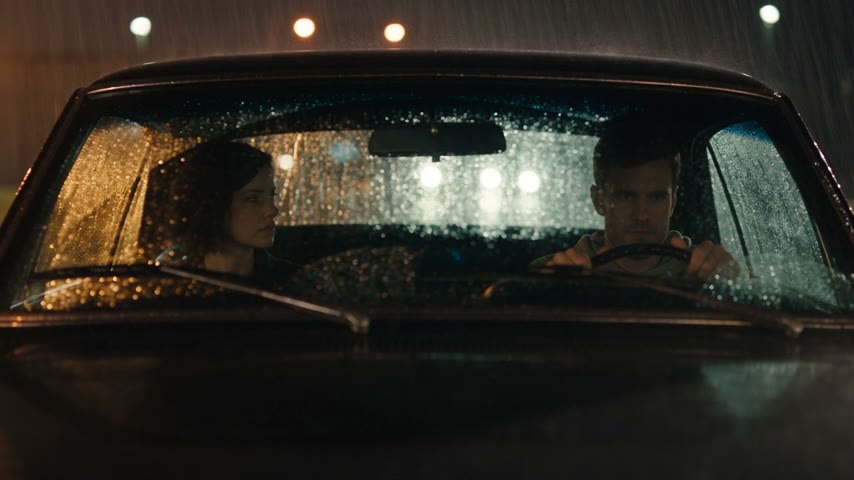
Three shots with cuts. Cinematic and realistic. Night, the warm glow of a dashboard. Inside a parked car in the rain. Shot 1 (0-2 s): a wide shot through the windscreen of a young couple in the front seats, rain running down the glass. Shot 2 (2-5 s): a close-up of the woman in the passenger seat, mid-twenties, short black hair; she says quietly: "We can't keep doing this." Shot 3 (5-8 s): a close-up of the man at the wheel, mid-twenties, stubble, grey hoodie; he grips the wheel and answers: "Then tell me what you want." Sound: rain on the roof and their voices; no music.
1. Escreva uma cena, não um clipe
Agrupe a ação conectada em cenas de até uns 30 segundos e escreva cada uma como um único pedido, com seus planos internos. Mantenha juntos a preparação, a resposta e o desfecho de um acontecimento. Cada ponto em que duas gerações separadas se encontram é um ponto em que os personagens, a atuação e o som precisam ser recuperados; por isso, menos pedidos, e mais longos, se sustentam melhor. Uma cena curta precisa só do tempo que usa.
Uma cena pode ter cortes. Diga onde a vista muda e onde o mesmo plano continua; “uma cena” não quer dizer um único take sem interrupção. Faça o fim de cada momento preparar o próximo: numa perseguição, mostre o que faz os personagens virarem antes de mandá-los de volta pelo outro lado. Encene o plano aberto, o close, o contraplano e a reação dentro do mesmo pedido, e dê tempo suficiente a uma reação importante para escolher o corte dela depois. Separar tudo isso em gerações diferentes perde a atuação: repetir a descrição da cena e as imagens dos personagens não carrega o que acabou de acontecer.
2. Dê a cada plano uma vista, uma ação, uma voz e um som
Abra com a situação e o visual, depois as funções das referências, depois os planos em ordem. Para cada plano, diga a vista, a ação ou reação que importa, quem fala e exatamente o quê, e o som que devemos ouvir. Mova a câmera para revelar ou acompanhar algo específico, e não amontoe vários movimentos de câmera num intervalo curto.
Intervalos em segundos inteiros organizam a progressão, mas são direção, não um relógio de edição: confira onde as coisas acontecem de fato antes de sincronizar legendas, música ou uma voz substituta com elas. E termine todo prompt com “No text. No subtitles.” (“Sem texto. Sem legendas.”): o modelo pode errar letras ou inventar legendas, então títulos e legendas ficam para a edição.
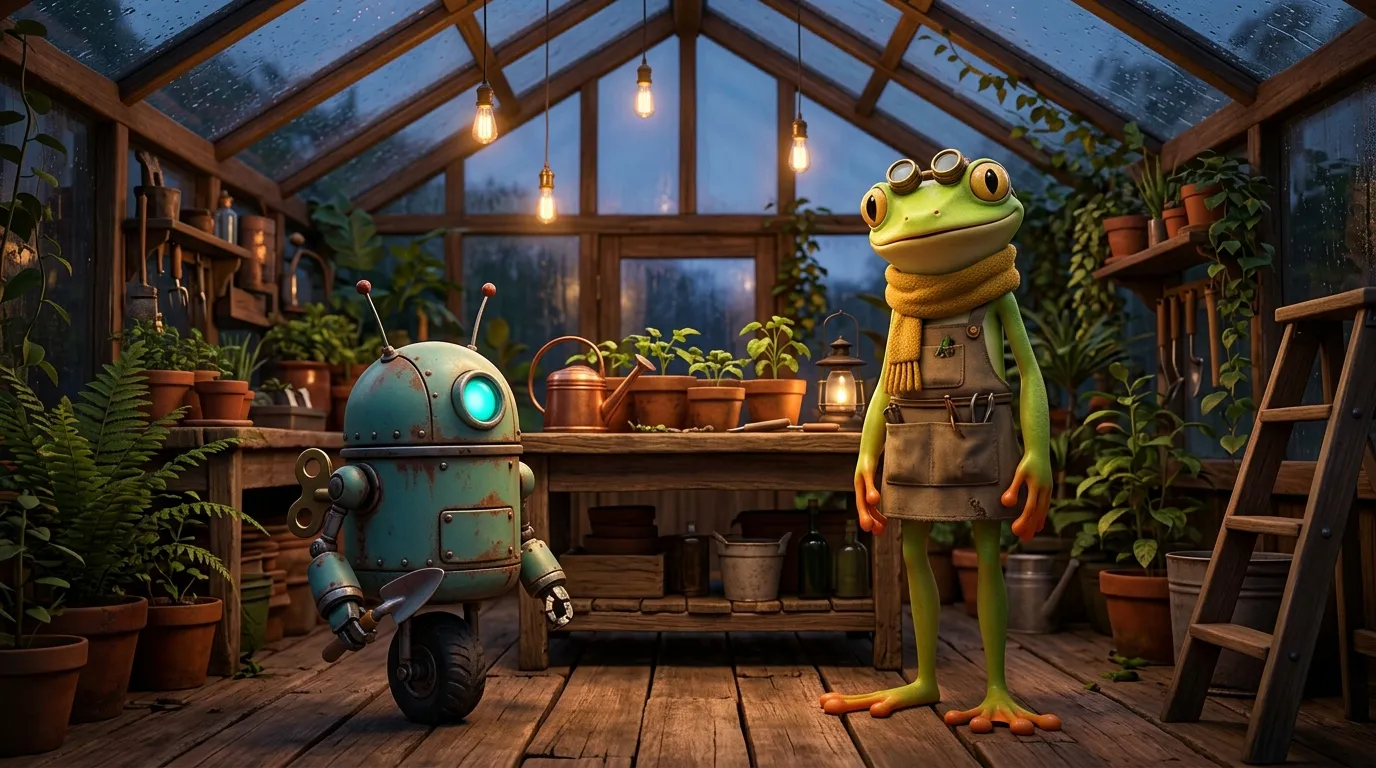
Audio policy (all shots): the two characters' spoken lines, the marked sound effects and steady rain on the glass roof, plus the one light music theme marked below. No subtitles. A continuous comedy scene in one location, a rainy greenhouse workshop at dusk, in eight shots, 3D animated feature-film style. @Image 1 is the character-and-location sheet: take the two characters' designs and the greenhouse workshop from it, and take nothing else from it. On the left of @Image 1, Bolt: a small round teal tin robot with one large round cyan eye-lens, two thin antennae with red bulb tips, stubby clamp hands, rolling on a single black rubber wheel. On the right of @Image 1, Fern: a tall slender lime-green tree frog standing upright, with big golden eyes, a mustard-yellow knitted scarf, a canvas work apron and brass goggles pushed up on her forehead. The workshop: a peaked glass roof, a long wooden workbench with a row of seedlings in clay pots, warm hanging bulbs, a wooden stepladder on the right, cool blue dusk light through the glass and warm amber light inside. Music: (a light, playful pizzicato strings theme, steady medium tempo, quiet under the voices, 0-30s). Shot 1, 0-3s: wide shot of the workshop, static camera. Fern, the tall green frog in the yellow scarf, stands at the workbench on the right, watering the seedlings. A drop of water falls from a crack in the glass roof onto a seedling. <rain patters on the glass roof> <a single drip taps a clay pot> Shot 2, 3-6s: medium close-up of Fern, slight low angle. She looks up at the roof, eyes wide, and calls out. Fern, the tall green frog (a warm, quick, mid-range female voice): "Bolt! The roof is leaking on my seedlings!" Shot 3, 6-10s: medium shot, the camera tracking left to right. Bolt, the small teal robot with the cyan eye, rolls in fast from the left carrying a dented tin bucket over his head and sets it under the drip. Bolt, the small teal robot (a bright, small, slightly tinny boyish voice): "Bucket deployed!" <wheel squeak> <a drip plinks into the metal bucket> Shot 4, 10-13s: the same medium shot continues without a cut: Bolt, beside the bucket, looks up as a second and then a third drip start falling beside the first onto the bench. <drips tapping wood> Shot 5, 13-17s: two-shot at bench height, Bolt on the left and Fern on the right. Bolt's eye-lens flicks between the three drips; he holds up his one bucket. Bolt, the small teal robot (a bright, small, slightly tinny boyish voice): "Three leaks. One bucket." Fern grabs a roll of silver tape from the bench. Shot 6, 17-20s: medium shot. Fern climbs the wooden stepladder on the right, tape in hand, while Bolt rolls over and grips the ladder's legs with both clamp hands. Fern, the tall green frog (a warm, quick, mid-range female voice): "Hold the ladder steady!" <ladder creaks> Shot 7, 20-25s: the ladder shot continues without a cut, then the camera tilts up to a low angle past Bolt's antennae. At the top of the ladder, Fern tears a strip of tape and presses it over the crack; the ladder wobbles and Bolt braces it, his wheel skidding. <tape tearing> <ladder rattles> Fern (warm female voice): "Got it!" Shot 8, 25-30s: close-up of Bolt, the small teal robot, looking up proudly. One last drop falls and lands right on his cyan eye-lens; his lens shutter blinks twice. Bolt, the small teal robot (a bright, small, slightly tinny boyish voice), deadpan: "Except this one." Fern, the frog above, laughs softly off-screen. <a drip taps metal> <soft rain continues> Keep the characters' designs, sizes and screen sides consistent in every shot: Bolt reaches about Fern's hip; Bolt on the left, Fern on the right unless a shot says otherwise. The light stays cool blue dusk outside and warm amber inside throughout. Sound: only the two voices, the marked effects, steady rain on the glass and the one pizzicato theme. No subtitles, no text or logos.
-
take the two characters' designs and the greenhouse workshop from it, and take nothing else from it
A única imagem de referência recebe uma função e um limite.
-
Fern, the tall green frog in the yellow scarf
Cada ação nomeia quem a faz pela aparência, não só pelo nome, para o modelo ligá-la ao personagem certo.
-
the same medium shot continues without a cut
Onde a câmera não corta também fica escrito.
-
<a drip plinks into the metal bucket>
Cada som fica ligado à coisa que o produz na tela.
-
No subtitles, no text or logos.
Letreiros entram na edição, nunca pelo modelo.
3. Ligue cada referência a uma função
As referências são numeradas dentro de cada tipo, na ordem em que são anexadas: @Image 1, @Image 2, @Audio 1,
@Video 1. Escrever um identificador não anexa nada, então confira a lista real e atualize o prompt sempre que as
entradas mudarem. Depois dê a cada referência uma função e diga o que ela fornece:
- Uma imagem define uma identidade, uma aparência atual, um lugar, uma composição, um estilo ou uma pose de abertura. Diga quais qualidades manter e quais a cena muda.
- Um áudio dá a voz de quem fala, uma interpretação exata a seguir, ou música. Ligue cada personagem que fala à sua própria amostra e diga para pegar a voz, não as falas antigas nem o fundo.
- Um vídeo é um momento a continuar, um movimento ou atuação a seguir, ou material a editar. Diga qual.
Ligue ações e falas à descrição visível e à posição do personagem, além do nome: “o pequeno robô verde-azulado carrega o balde”, não só “Bolt”. Esta cena da corte tem cinco pessoas e um lugar para manter em ordem, então o prompt liga sete imagens e duas amostras de voz, cada uma a uma pessoa. Aponte para um cartão para ver onde o prompt o usa.
O salão
Rei Wu Ding
Que, o adivinho
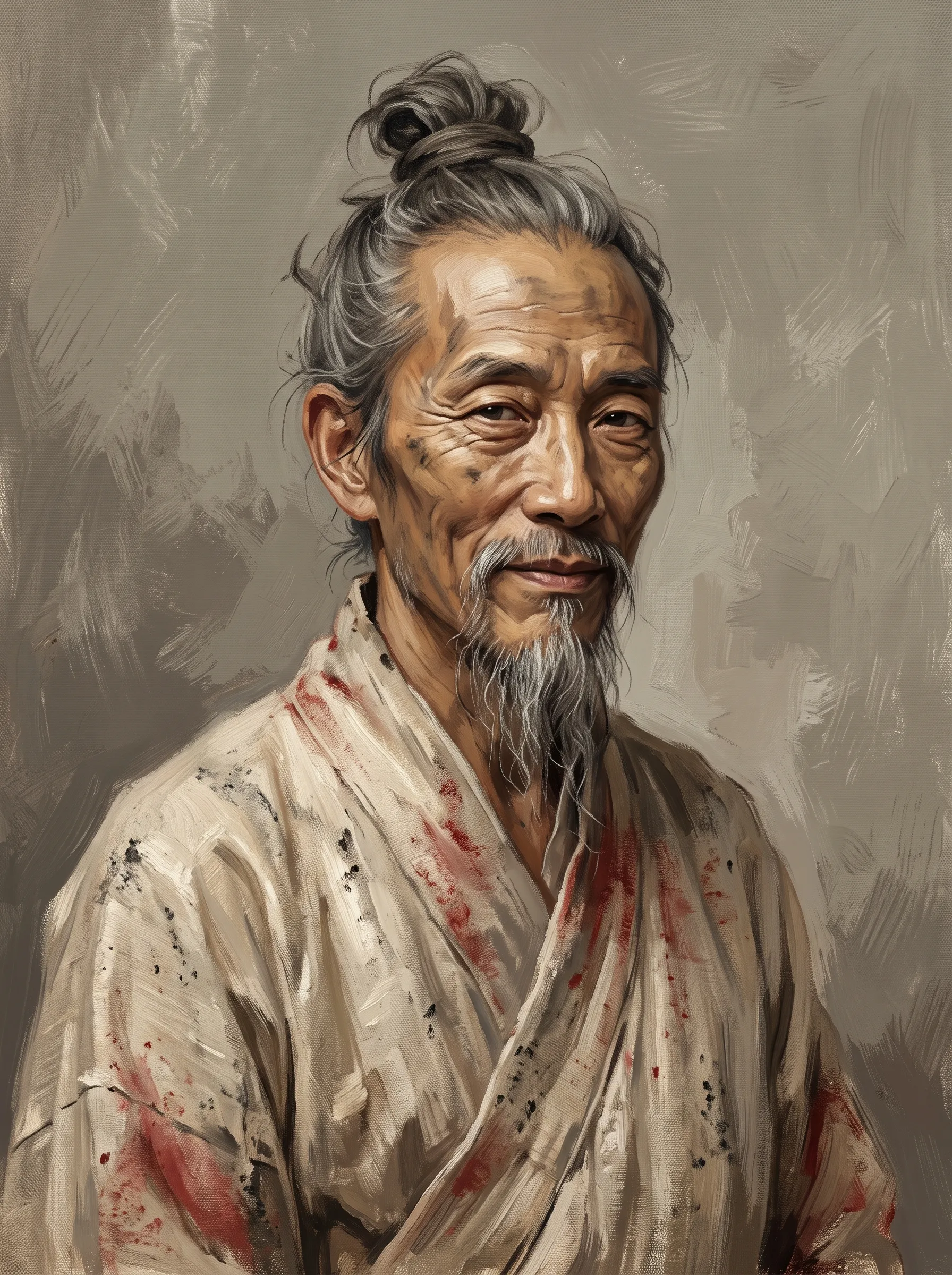
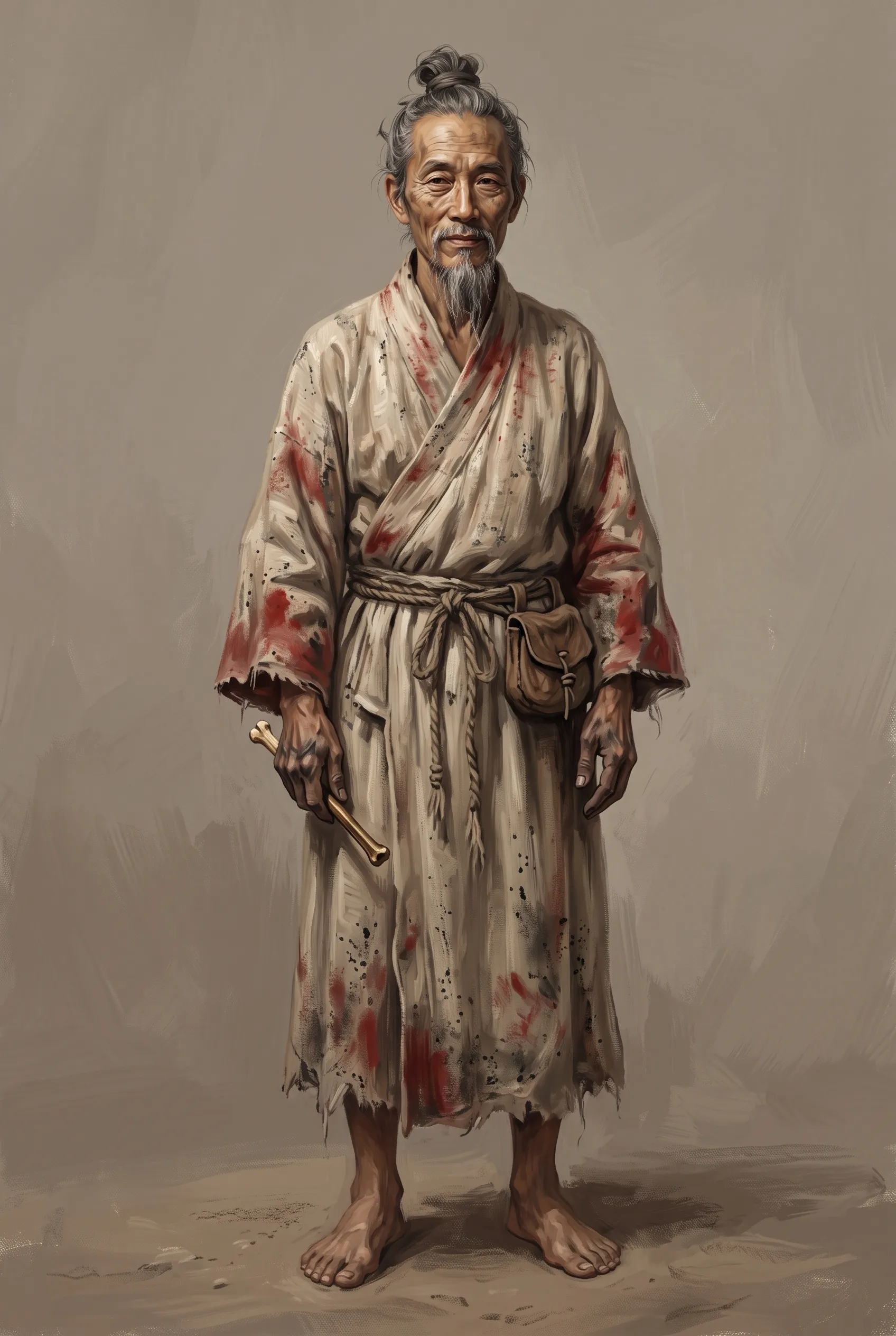
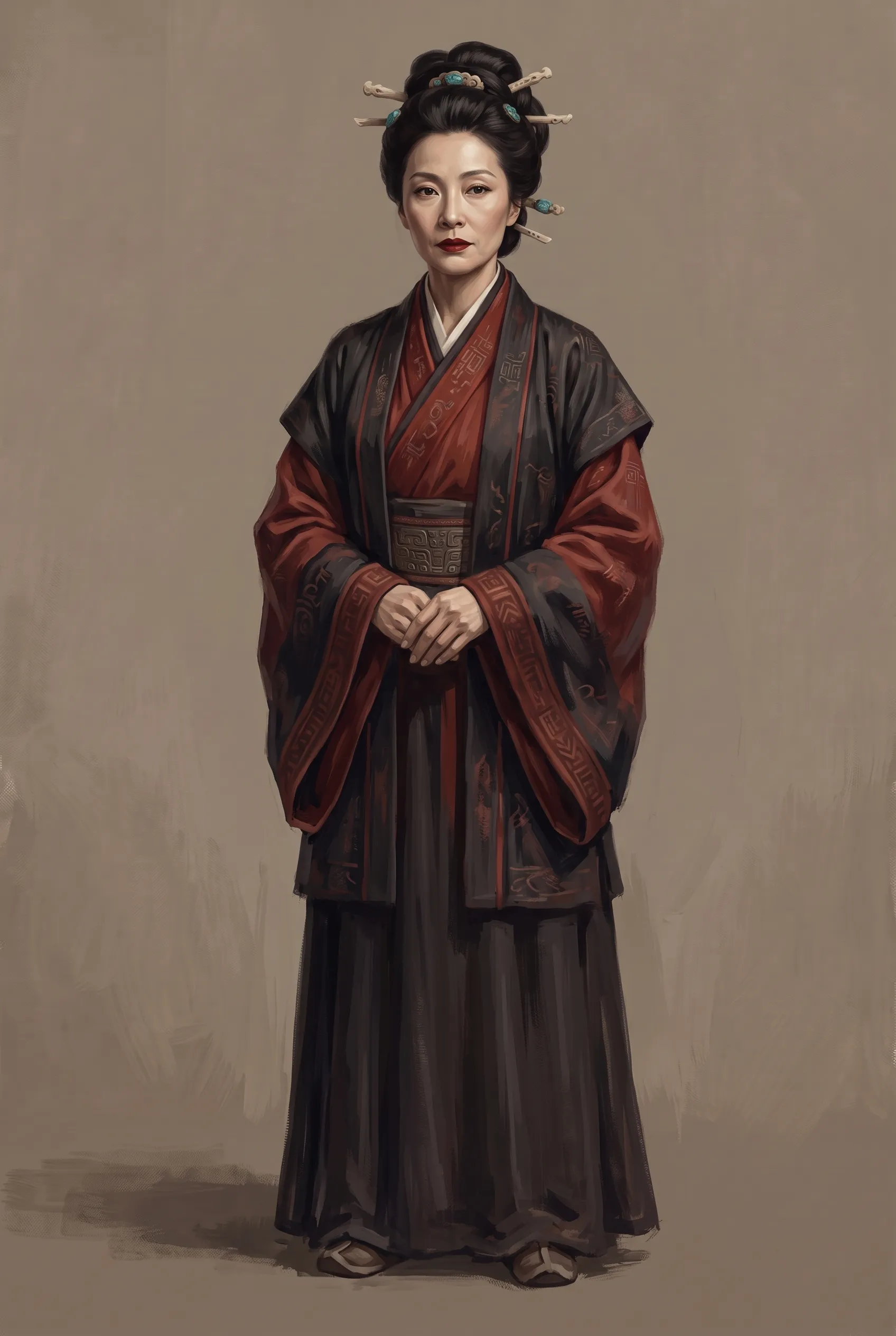
Senhora Jing
Príncipe Ji
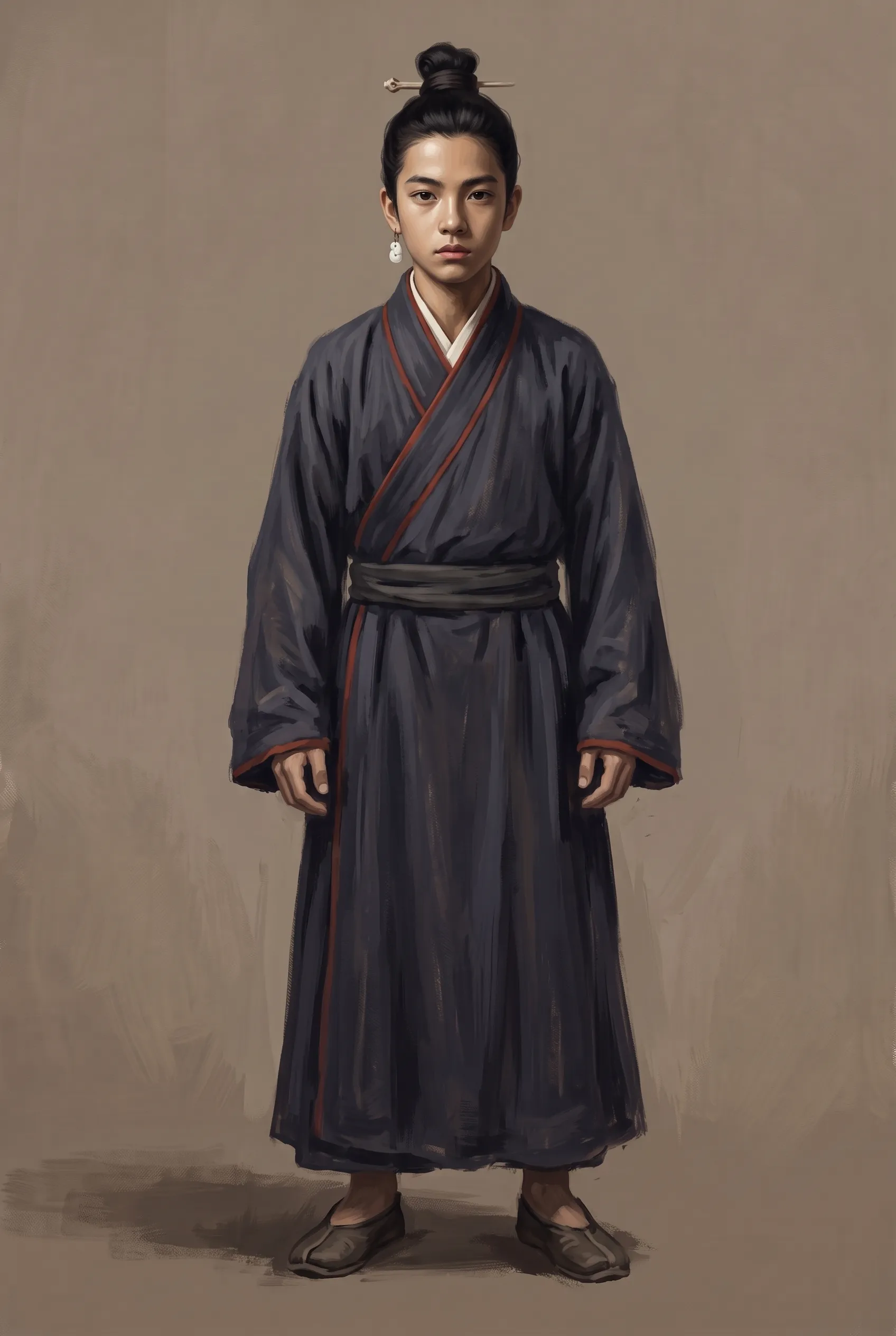
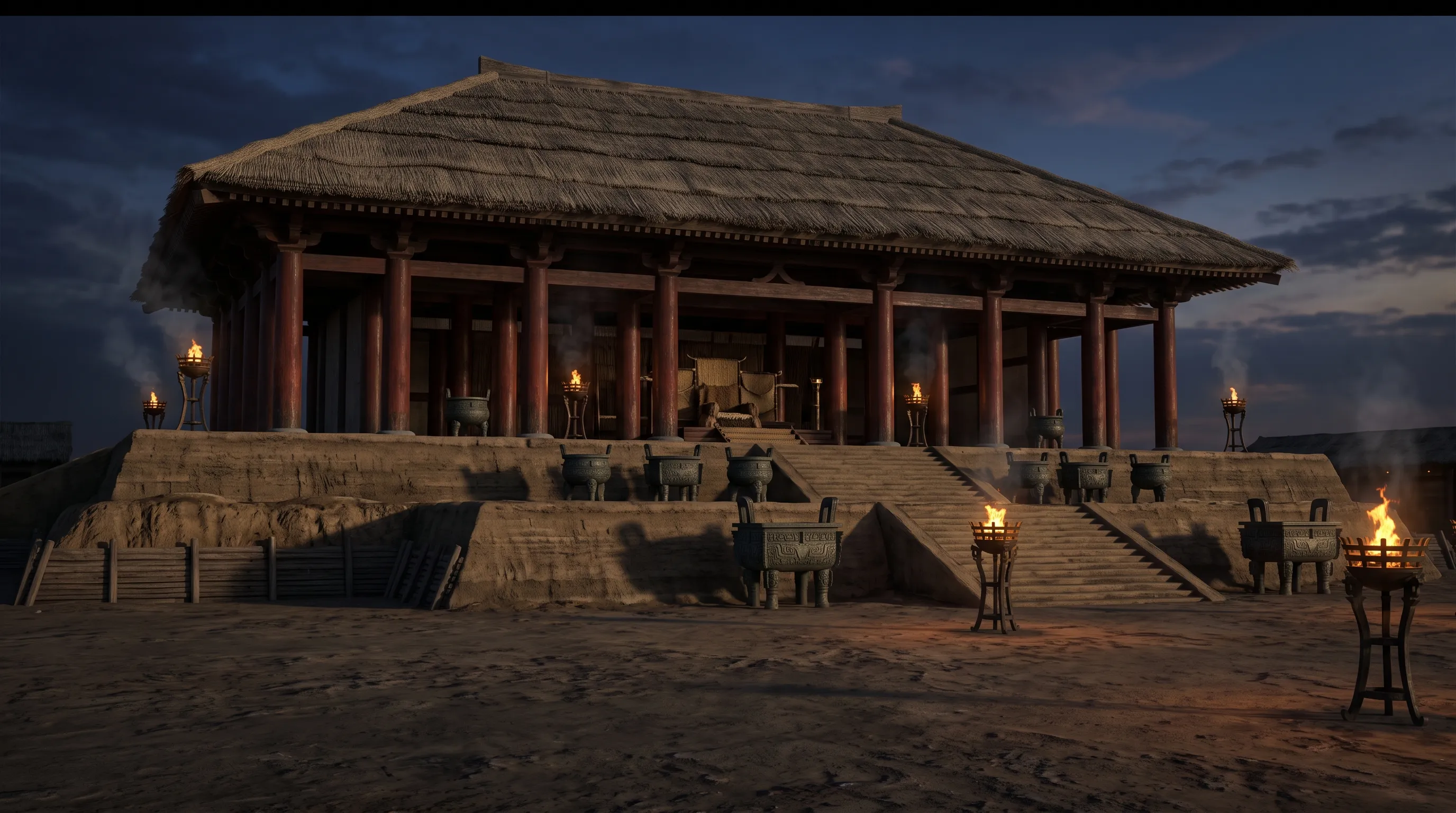
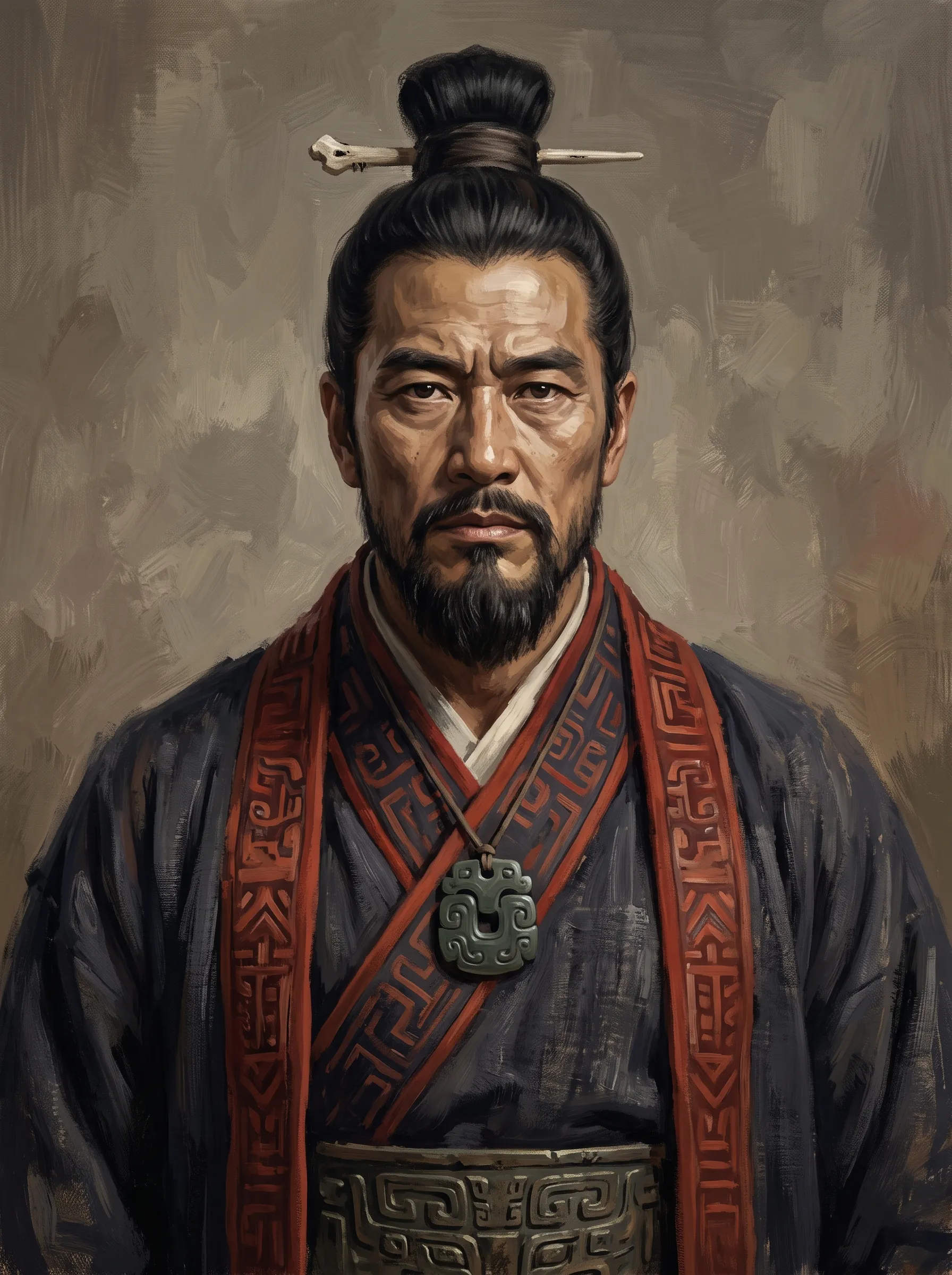
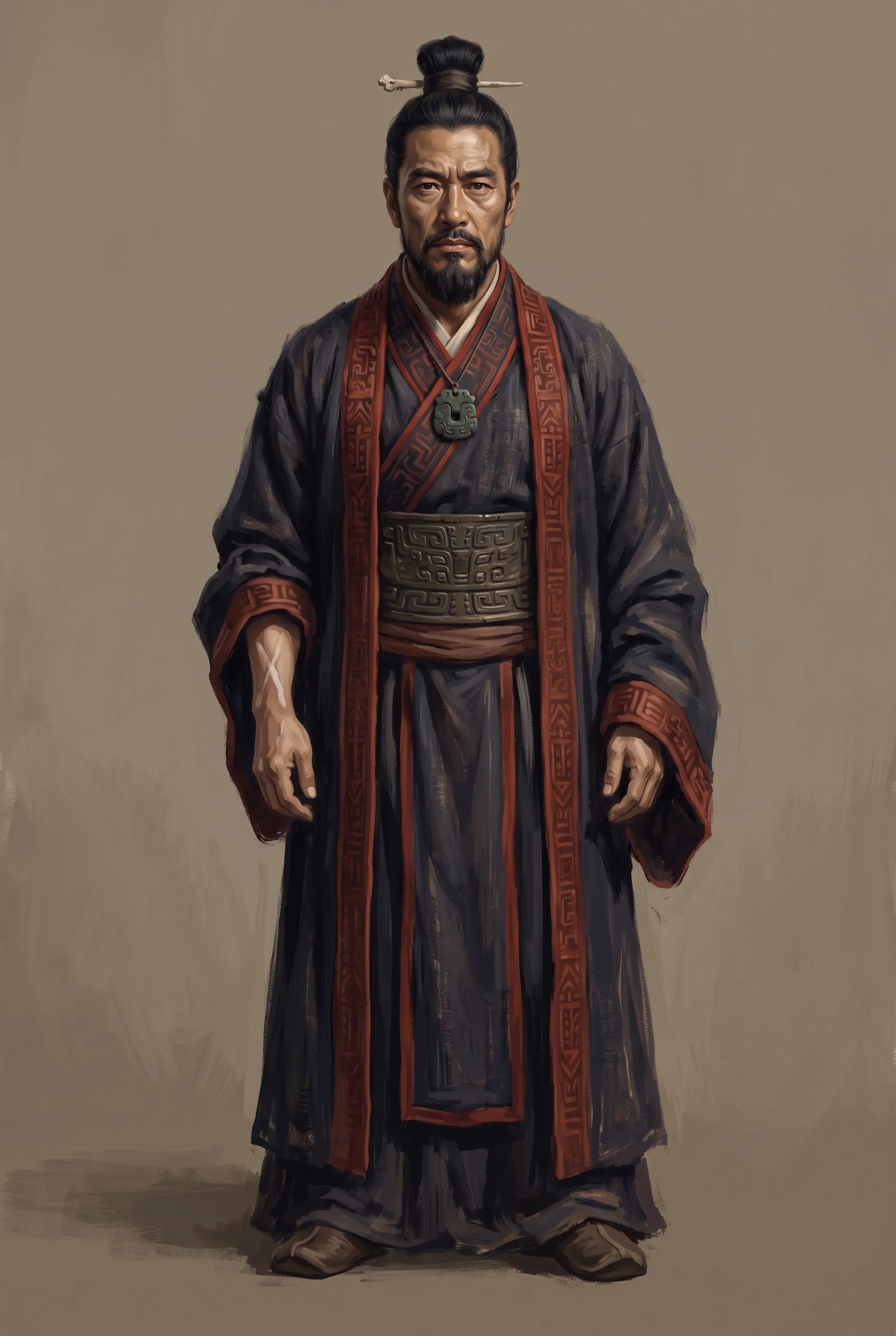
A 30-second scene at dusk in the Shang capital of Yin, about 1250 BCE, in a torchlit open-fronted thatched hall on a rammed-earth platform. Cinematic live-action historical drama, 35 mm anamorphic look, deep amber torchlight and blue dusk, ochre, indigo and charcoal tones with cinnabar-red accents. Use @Image 7 for the setting: the thatched hall, red wooden pillars, throne mat, bronze ding vessels and torch stands. Courtiers in muted hemp and indigo robes line the walls. Use @Image 1 and @Image 2 for KING WU DING: a tall broad-shouldered man of about forty, severe calm face, short square-cut black beard, dark indigo layered robe with cinnabar-red border, bronze belt plate, jade pendant, topknot with a bone hairpin, no crown. Use @Image 3 and @Image 4 for QUE: a narrow man of about fifty-five, thin grey topknot, long thin grey beard, undyed hemp robe with cinnabar stains on the sleeves. Use @Image 5 for LADY JING: an elegant woman of about forty, cinnabar-painted lips, hair in a high coil with bone and turquoise pins, layered black-and-red silk robe, still hands. Use @Image 6 for PRINCE JI: a slim serious boy of fifteen, indigo robe, topknot, a white jade ear ornament. Keep all faces and costumes exactly as in the references, as real people, not paintings. @Audio 1 is the King's deep, low, heavy voice: use it whenever the King speaks. @Audio 2 is Que's raspy, gentle, ironic older voice: use it whenever Que speaks. Take voice identity only, not the old lines or background sounds. Shot 1, 0-5s: Wide establishing view down the hall, slow push in. Torches flicker; courtiers line both walls in silence. King Wu Ding enters without a word from the far end and kneels on the throne mat. Lady Jing and Prince Ji stand beside the mat. The court goes quiet. Shot 2, 5-12s: Medium on Que kneeling before the king. Que offers a bronze rod with both hands and says, formally and clearly, "On Gway-sih day, Chweh divines: will the rain come within ten days?" Que bows his head. Shot 3, 12-20s: Over the King's shoulder: the king takes the rod and presses it himself into a drilled pit on a flat pale turtle plastron (the flat belly shell of a turtle, with a central seam, never a round or pearly shell) lying on a cloth. Slow macro on the shell. A thin curl of smoke. A sharp tick; a crack runs across the shell. Sound: tick, breath. Shot 4, 20-26s: Close on King Wu Ding's severe face, staring at the crack. A long pause; everyone waits. He says, low, slowly, in one clear word: "Rain." Shot 5, 26-30s: Slow wide of the court as it breathes out. Prince Ji smiles with relief; Lady Jing watches the king's face, not the shell. A single deep bronze bell sounds. Period guardrails: bronze, wood, bone, hemp and clay only; no iron, no modern objects, no tiled roofs, no stone walls, no visible writing. Only the two quoted lines, spoken by those speakers. No music. No subtitles, text or logos.
As duas amostras de voz são trechos limpos das vozes do Rei e de Que em cenas anteriores da mesma produção. Só uma descrição escrita da voz é uma orientação mais fraca; uma amostra curta, com uma pessoa falando, palavras completas e pouco fundo, leva a voz de uma cena para a outra.
4. Comece de um frame exato
Quando a composição de abertura importa com exatidão, dê a imagem como primeiro frame, não como referência. Chamar uma imagem de referência de “primeiro frame” no texto só pede uma abertura parecida. Um primeiro frame carrega a pose e a posição, mas não o movimento, a voz ou o ambiente, e não pode ser combinado com imagens de referência no mesmo pedido (referência da API de vídeo do BytePlus, em inglês).
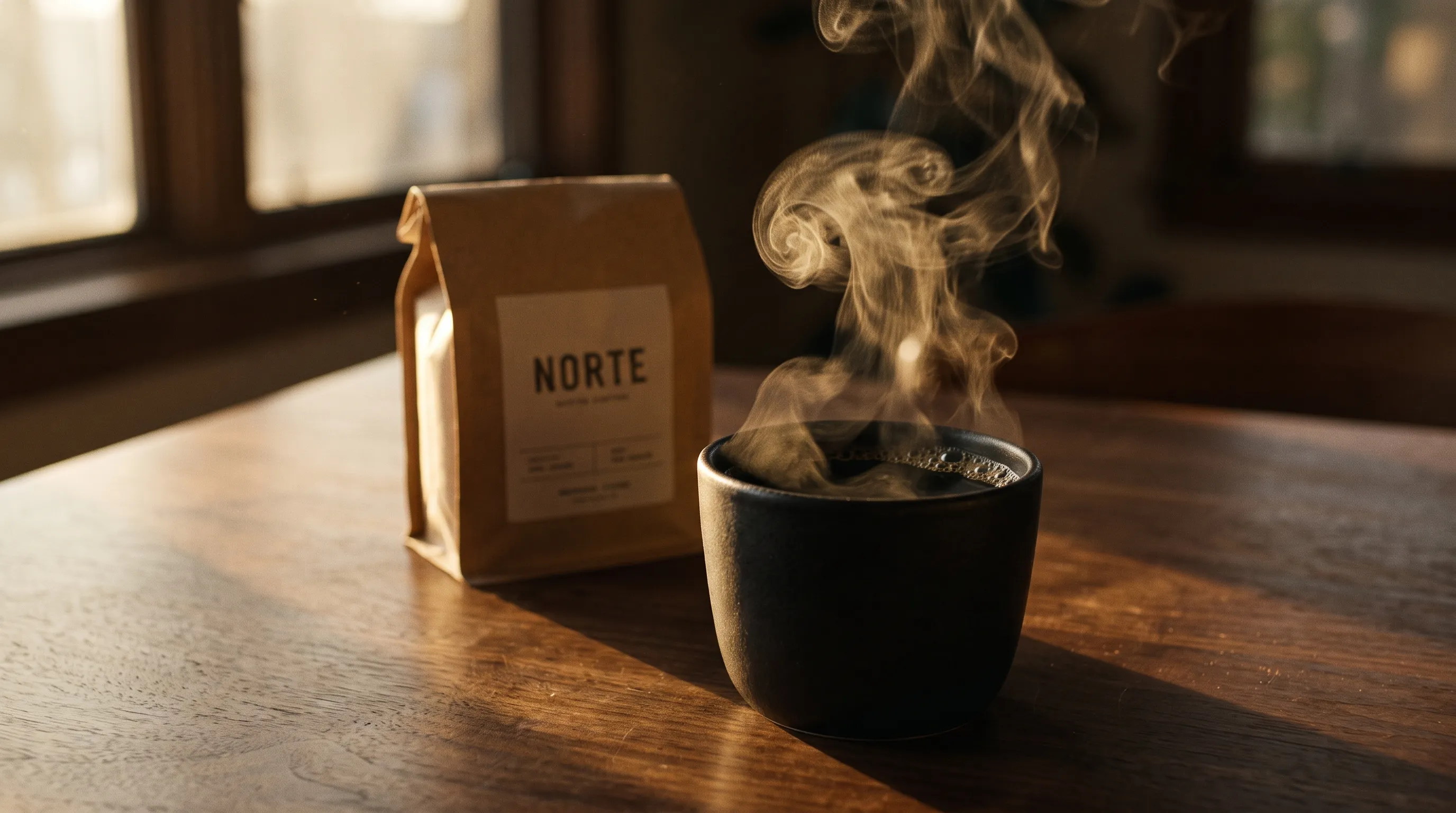
primeiro frame Seedance
Shot 1, 0-3s: start exactly on the opening frame; a very slow push-in toward the black ceramic cup as the backlit steam curls and swirls in graceful spirals in the sunbeam.
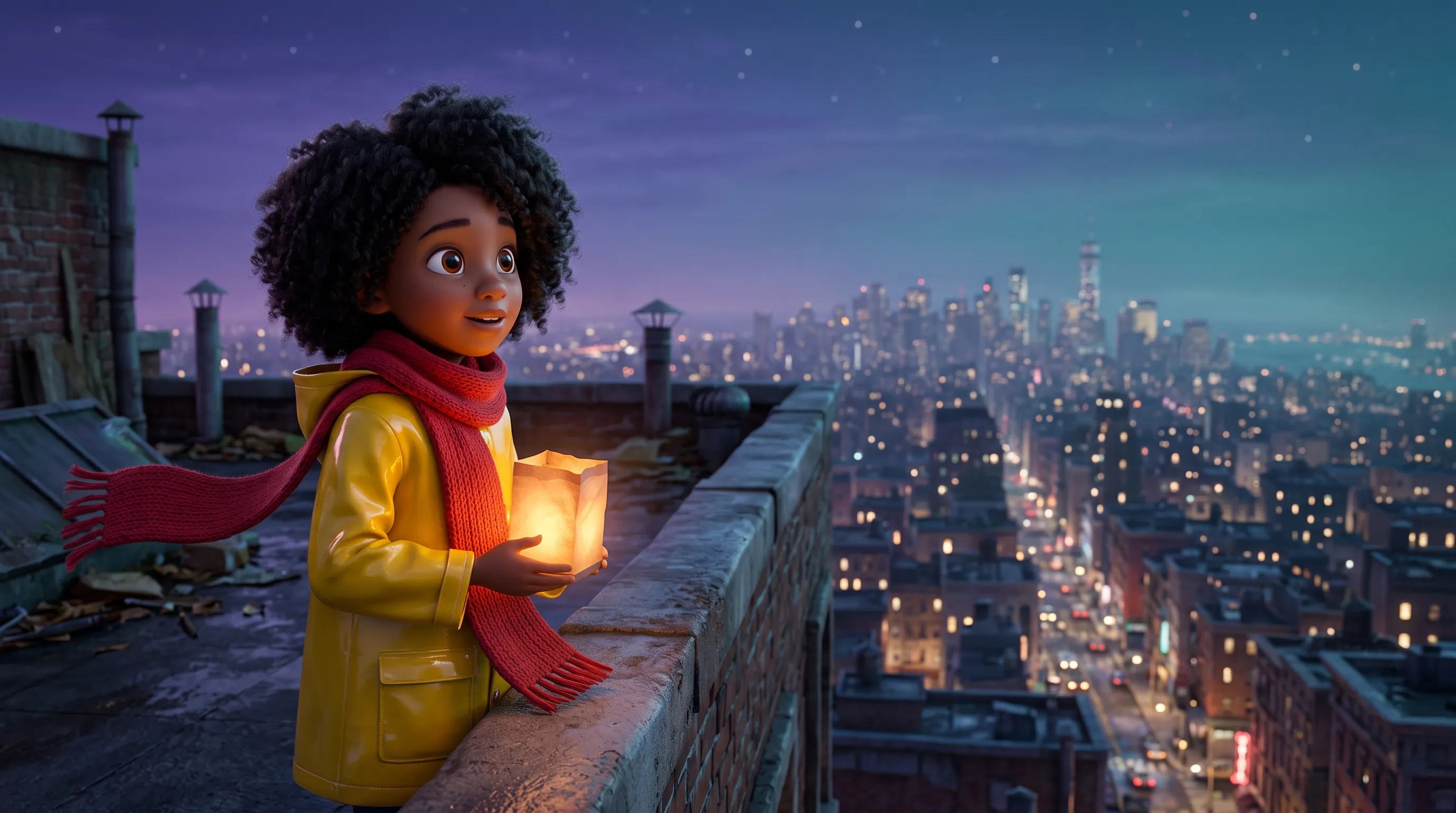
primeiro frame Seedance
Shot 1, 0-4s: medium shot from the opening frame; the wind lifts her red scarf, she smiles with wonder, raises the glowing lantern in both hands and gently lets it go; it floats up past her face, warm light sweeping across her cheeks.
5. Continue uma cena sem emenda
Quando uma cena passa de uma geração, primeiro escolha o último momento que fica na edição e depois decida como o próximo pedido usa o material anterior. Use o próprio material aprovado, não outra descrição dele:
| O que você quer | Como pedir | O que o prompt diz |
|---|---|---|
| Continuar a mesma ação | Modo de extensão, com os últimos segundos que você manteve como @Video 1 |
Continue a partir do fim do @Video 1: a nova ação e os cortes, mantendo posições, movimento, luz e som |
| Continuar a partir de uma pose exata | O último frame mantido como primeiro frame | Comece deste frame e dirija o que acontece em seguida |
| Uma cena nova com o visual ou o movimento de antes | Modo de referência, com o trecho útil como @Video 1 |
Quais qualidades o @Video 1 fornece, e qual é a cena nova |
| Mudar um clipe existente | Modo de edição, com o trecho inteiro a mudar | A mudança precisa, e a ação, o tempo, as pessoas e o som a manter |
Para estender, corte os segundos finais do trecho mantido e confira antes os últimos frames dele: um corte ou um close indesejado no fim vai conduzir a continuação. Depois examine os dois lados de cada emenda, na velocidade normal e de perto: um momento repetido, um salto de identidade ou de posição, impulso perdido, uma mudança de luz ou um som que recomeça.
Esta emenda é de uma produção que pediu para “continue the scene of @Video 1 without a visible cut” (“continuar a cena
do @Video 1 sem um corte visível”). O pedido anexou os últimos oito segundos do clipe anterior como @Video 1, mas sem
escolher o modo de extensão, e a continuação abre num novo posicionamento de câmera. A conferência leva dez segundos e
pega o problema antes da edição:
Último frame do @Video 1
Primeiro frame da continuação
A emenda
6. Dirija o som junto com a imagem
Mantenha o áudio nativo quando diálogo, ambiente ou efeitos pertencem à cena. Descreva o ambiente como o som contínuo do lugar (chuva no vidro, o som da sala) e mantenha-o igual nos cortes que continuam ali. Ligue cada efeito à sua causa visível e depois confira a sincronia: a ação pode cair num segundo diferente do que você pediu. Para música que precisa ser contínua ao longo de uma produção, gere a trilha separadamente e peça ao Seedance vozes, ambiente e efeitos sem música. O guia de trilha sonora e design de som trata dessa trilha.
O diálogo nativo do Seedance 2.5 cobre onze idiomas: chinês, inglês, espanhol, indonésio, malaio, tailandês, árabe, português, vietnamita, japonês e coreano (tutorial do Seedance 2.5 no BytePlus, em inglês). O agente do Bald Rhino o usa para diálogos em inglês e em chinês; para outros idiomas, e sempre que as palavras precisam ser exatas, ele prepara a fala antes com um modelo de voz e a usa como referência de áudio de quem fala. Em qualquer caso, ouça cada fala atrás de palavras erradas, pronúncia, a pessoa errada falando ou frases faltando. Um primeiro clipe bom não libera os seguintes.
7. Assista à cena inteira, depois conserte na causa
Assista à ação completa e ouça o som completo antes de julgar um detalhe. Confira se cada referência manteve a identidade, se cada fala saiu da pessoa certa, se as ações importantes aconteceram, se as emendas se sustentam e se não entraram legendas ou música. Mantenha os planos que servem à cena, mesmo que o modelo tenha mudado um enquadramento que não importava. Quando algo essencial está errado (uma saída que falta, personagens trocados, um desfecho que nunca chega), corrija a causa: o mapeamento das referências, uma encenação apertada demais, uma ação que o prompt deixou de fora ou a própria edição. Depois revise as emendas dos dois lados do conserto.