
A character drifts when each new image or clip is asked for differently: new synonyms, a forgotten detail, a reference that also carries the old pose and background. The fix is not more reference images. It is one accepted design, one description that never changes, and a clear job for every reference. Below, Lia keeps her identity across five scenes. Her accepted design stays pinned while the scenes scroll past; switch between what stays the same in every prompt and what each scene changes.
-
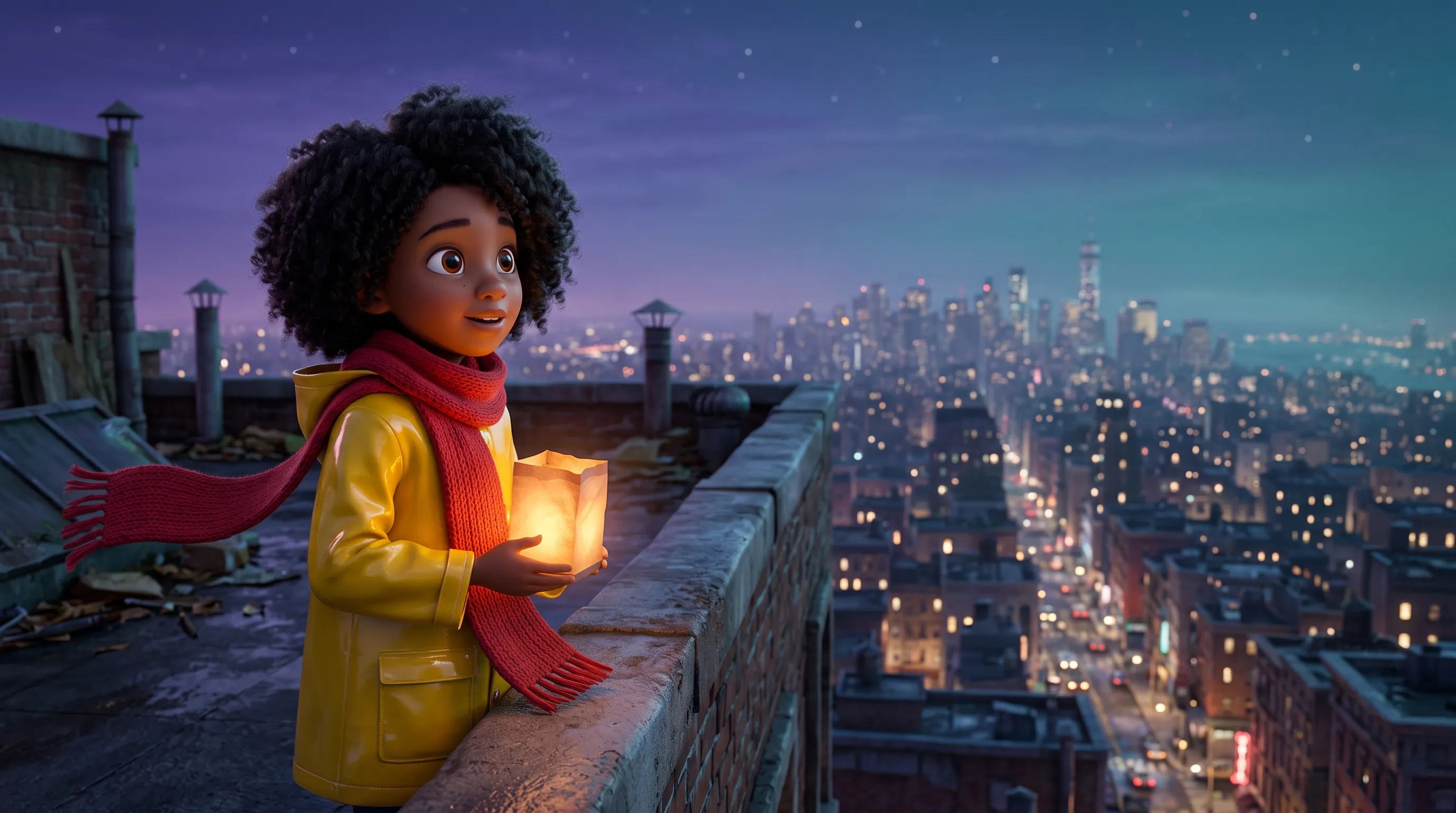 The accepted design The accepted design
Still from a high-end stylized 3D animated feature film. A 10-year-old girl named Lia with big expressive brown eyes, warm brown skin, a voluminous cloud of short curly black hair, wearing a bright yellow raincoat and a long red knitted scarf, stands on the edge of a city rooftop at blue hour, holding a small glowing paper lantern. Wind lifts her scarf. Behind her a vast city of lights stretches to the horizon under a deep violet and teal sky with the first stars. Wide cinematic composition, Lia on the left third, looking out toward the city with wonder. Soft rim light, volumetric haze, rich color, 16:9.
-
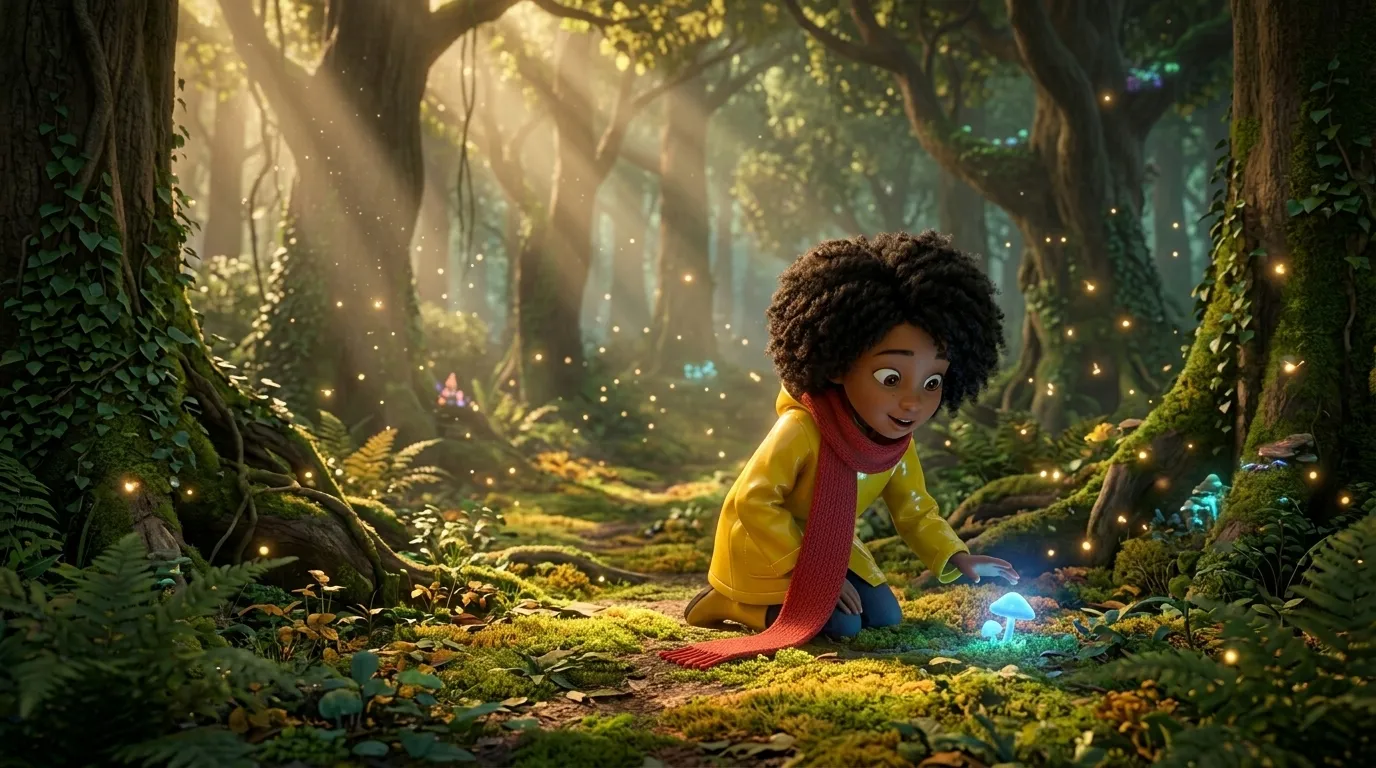 The forest
Using Image 1 only for Lia's character design (the girl with the voluminous curly black hair, warm brown skin, big brown eyes, glossy yellow raincoat and long red knitted scarf) and the stylized 3D animated feature film rendering: create a new scene. Lia kneels on a mossy path in an enchanted forest at golden hour, curiously reaching toward a tiny glowing blue mushroom, fireflies around her, god rays through tall trees. Medium-wide shot, Lia slightly right of centre. Same character proportions and outfit. 16:9.
-
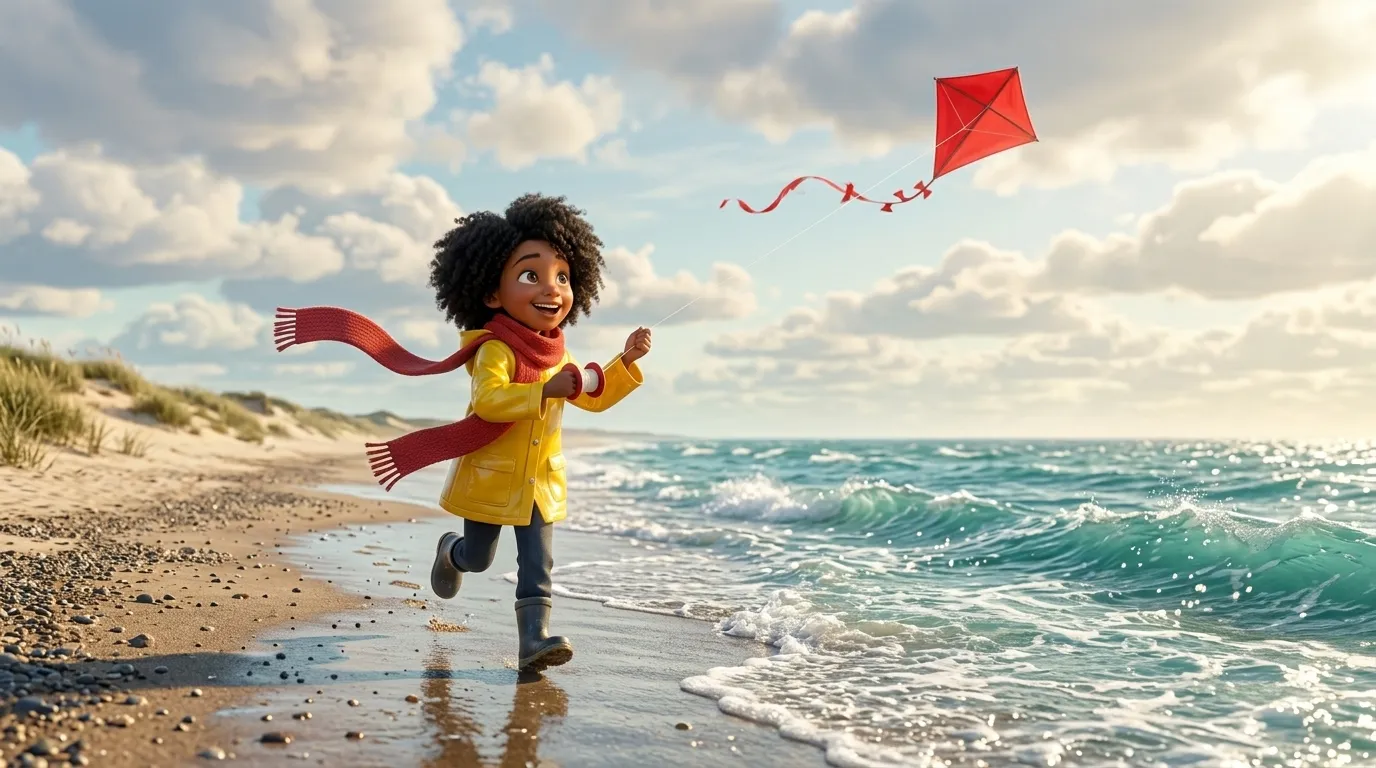 The beach
Using Image 1 only for Lia's character design (the girl with the voluminous curly black hair, warm brown skin, big brown eyes, glossy yellow raincoat and long red knitted scarf) and the stylized 3D animated feature film rendering: create a new scene. Lia runs joyfully along the edge of a turquoise sea on a bright windy morning, flying a red kite, scarf streaming behind her, sparkling waves, puffy clouds. Wide shot, dynamic. Same character proportions and outfit. 16:9.
-
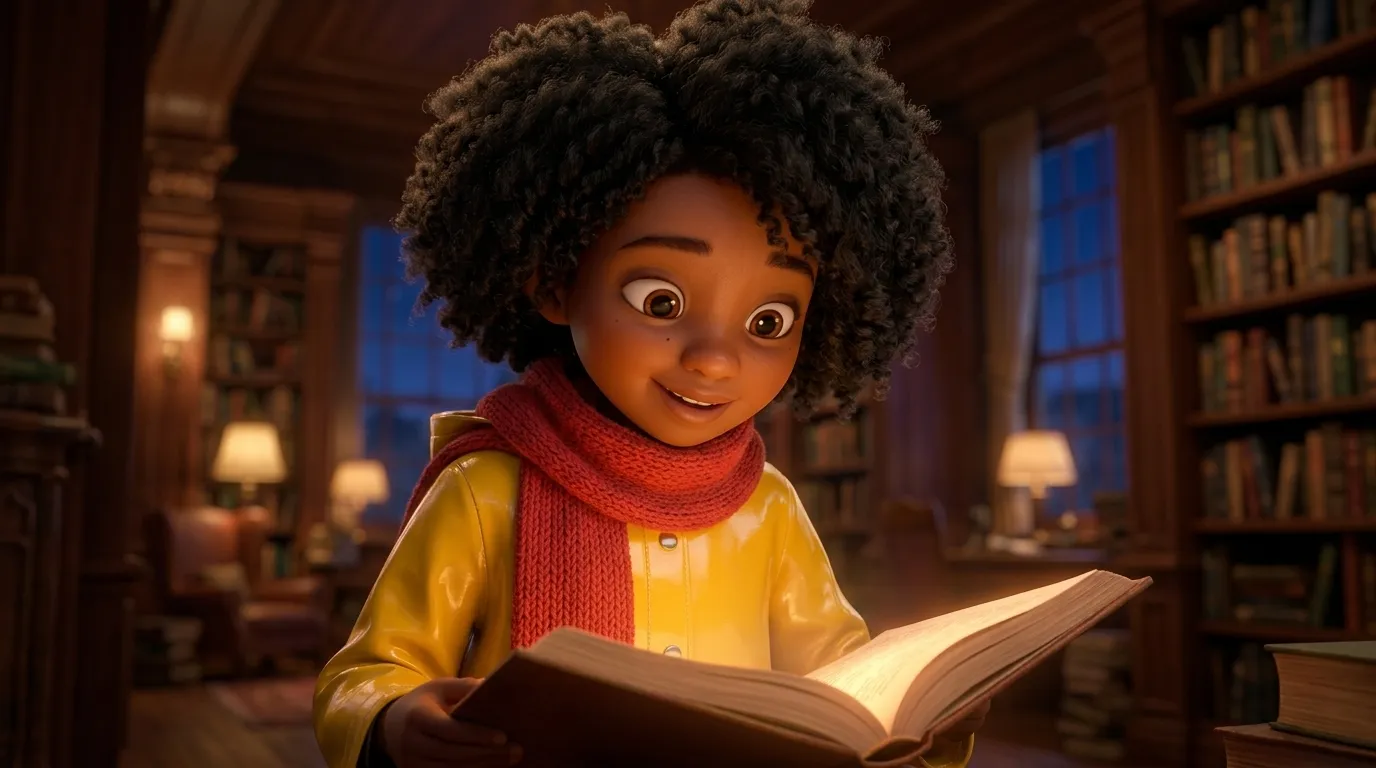 The library
Using Image 1 only for Lia's character design (the girl with the voluminous curly black hair, warm brown skin, big brown eyes, glossy yellow raincoat and long red knitted scarf) and the stylized 3D animated feature film rendering: create a portrait close-up of Lia inside a cozy library at night, warm lamp light, reading an open glowing storybook, delighted expression, shelves softly blurred behind. Same face and outfit. 16:9.
- In motion
A scene from a high-end stylized 3D animated feature film, continuing from the opening frame. Lia, the little girl with a cloud of curly black hair, yellow raincoat and long red scarf, stands at the rooftop ledge at blue hour holding a glowing paper lantern. Shot 1, 0-4s: medium shot from the opening frame; the wind lifts her red scarf, she smiles with wonder, raises the glowing lantern in both hands and gently lets it go; it floats up past her face, warm light sweeping across her cheeks. Shot 2, 4-8s: cut to a wide shot from behind Lia: her small silhouette at the ledge as her lantern rises over the vast glittering city, and one by one hundreds of other warm lanterns rise from rooftops across the city, filling the violet and teal sky. Slow, majestic upward camera tilt. Keep Lia's design, proportions and outfit consistent. No text, no subtitles.
1. Give a character something to play
Consistency starts before the pictures. Give the character something they want, a reason it matters and a way they go after it, then decide what pressure shows a different side of them. Show those choices in behaviour the audience can see or hear: an apparently fearless companion keeps giving orders, then quietly steps between the danger and the youngster they call a nuisance. Develop relationships both ways, so neither character becomes only “the anxious one”.
Design for the performance too: silhouette, size, posture, expressive features, costume and how they move. A heavy, low figure and a gangly, quick one hesitate, run and help each other differently. Check a pair together, because their scale has to fit the actions the script asks for; a beautiful portrait alone can’t tell you how a body moves.
2. Keep one record, and one description
Write down what later images, clips and voices have to share, and keep it beside the selected files:
- Identity: proportions, facial features, markings, posture, clothing and props, with the images that establish them.
- Behaviour: aims, habits and contrasts, and the abilities the action depends on.
- Voice: the chosen voice or recording, its language and accent, its rhythm, and any deliberate change of register.
- Variants: which file is the base design and which a particular look, and what each variant changes.
Then describe the character the same way every time. Look at Lia’s prompts above: the identity words are repeated exactly in every request, and only the scene changes. New synonyms and extra features on each request slowly change the design. If the character is revised, update the description and the references together, so the next request doesn’t combine two versions.
3. Give every reference one job
Inspect the actual images before choosing them. A clear face view establishes likeness; a full-body view establishes silhouette and posture; a shared frame establishes relative scale. A turnaround helps a recurring animated character, but its views must agree with each other. Then separate what each image is for: identity, rendering style, composition, pose or scene state. Lia’s scenes use the accepted design for exactly two jobs, her design and the film’s rendering, and say so: using Image 1 only for. Without that, the new scene would inherit the rooftop, the night and the lantern too.
For two characters, bind each one’s reference to what the scene asks of them:
| Reference | What it supplies | What the scene adds or changes |
|---|---|---|
| The young dinosaur’s accepted sheet | Beak, proportions, markings and expressions | It lies on its back at the left, playing dead |
| The older mammal’s accepted sheet | Face, fur, four-legged posture and build | It stands at the right, looking down, the shell in its jaws |
| The accepted riverbank image | The tree, the burrow, the river and the light | The characters take the positions asked for |
Bind each action to the visible subject as well as the name (“the dinosaur on its back”, “the furry mammal holding the shell”); names alone can leave a pose assigned to the wrong character. And match the written mapping to the files actually attached: a name, an earlier conversation or a path written in the prompt does not attach an image.
4. Let the story change the character, not replace them
Keep the stable identity separate from the temporary state. Wet fur, soot, an injury, a lost hat or an emotional turn has a cause and lasts as long as the story says. Build each variant from the accepted design, check what stayed the same, and don’t let the dry look come back by itself after the river scene, or mud become a permanent marking. Places work the same way: firelight or damage can change a location while its layout stays recognisable, and its sound should change with it.
A voice keeps its identity while its delivery changes: the same character can whisper, shout or falter. Keep the chosen voice source and a representative performance, and listen across neighbouring takes for a changed accent, register or recording, or a swapped speaker. A matching voice name or setting does not prove it sounds like the same performer.
5. Carry action, space and knowledge across the cut
Read the end of one scene against the start of the next: where everyone is, what they hold, what happened to their clothes and surroundings, what they now know. If a character ends inside a burrow and must pull someone out in the next shot, show the exit or make the time jump clear; matching their face does not repair a missing action.
For continuous action, start the next request from the last kept moment of the one before, not the end of the untrimmed clip. This greenhouse scene was first made as three 10-second requests; each new one attached the last four seconds of the clip before it and asked to “continue exactly from its last frame, with the same characters, positions, light and sound”. The join holds:
Last frame of the first request
First frame of the next
The join
6. Inspect the result, then repair the cause
Compare each result with its references and with the shots around it, at a size where a face can actually be judged; a small tile or a change of light can suggest drift that isn’t there. Name the specific problem first: the wrong subject doing the action, a changed design, a lost prop, a changed voice, a missing transition. Then repair it at the smallest useful scope, such as a clearer reference assignment, a replaced conflicting image or a restored exit, and check the repair with its neighbours. When a good change becomes part of the production, carry it into the references; when a result is rejected, keep it from becoming the reference for the next one.