
A video script is a plan for the picture and the sound at once: what the audience sees, hears and understands, in order, and why each moment leads to the next. It can be a narration, a dialogue, a table of shots, or no words at all. Below are two real scripts written by Bald Rhino’s agent, each played beside the film that was made from it.
1. What makes a video script hold attention?
A progression. Decide what the audience should understand, anticipate or feel by the end, then work out what has to happen for them to get there. Open on a specific promise or tension the piece can fulfil, plant what a later moment needs, and end on the changed understanding, decision, image or relationship the piece has earned.
The dialogue below opens with its whole conflict in under five seconds: “Aristotle. It’s two a.m. Why are you still scrolling?” Everything after it is the answer, and the ending turns the conflict into a quotable verdict. The wordless film opens differently: its first beat teaches a rule (the dog is old and slow, and the man waits for it), so that its last beat can break that rule without a word.
If two scenes could swap places without changing anything, look at whether each one is doing enough. A choice that matters needs a visible setup and a visible aftermath within the length you have; attractive shots alone don’t connect them.
2. What format does a video script use?
Use the format that keeps spoken words, visible action and production notes apart. For most videos that’s two columns, picture on the left and sound on the right, row by row, so you can see what the eye and the ear get at the same moment. A script can be wordless and still be a complete script. This one is:
The script's sound map
Beat 1: The walk
Teach the rule: the dog is old and slow, the man waits for it.
-
0:00 · Shot 1 · wide, low tracking from the front, slow
Picture Sun low over a flat wet beach; the old man and the old golden retriever walk toward camera along the waterline, the dog a few steps behind, stiff and slow. Warm backlight rims their fur and hair.In the film: Seen from behind, walking into the sun. After two refused requests the film was made without showing faces.
Sound Waves, steady wind, one far gull. Soft footsteps in wet sand. Faint collar-tag jingle, slow rhythm.
-
0:04 · Shot 2 · medium side tracking, shallow focus
Picture The man glances back, stops and waits. The dog catches up, grey muzzle in the light. They walk on side by side, matching pace; wet prints behind them.In the film: Framed low, on his legs and the dog walking beside them.
Sound Footsteps slow. Collar jingle. Waves.
Beat 2: Rest
The bond made closer.
-
0:09 · Shot 3 · medium, static, low angle
Picture At the dry sand the man sits down on a driftwood log. The dog lowers itself in stages and lies at his feet, head toward the sea. The man pats the sand beside him.In the film: From behind the log, the dog beside him.
Sound Waves. Cloth rustle, a soft sigh. The collar jingles once as the dog settles. A solo piano enters: one low sustained note.
-
0:14 · Shot 4 · close on the dog and the man's hand, slow push-in
Picture His hand rests on the dog's head, thumb stroking the grey fur. The dog's eyes are heavy, slowly closing, chest rising slowly. Last gold light.Sound The dog's slow breathing. Waves swell and recede. Two more piano notes, a simple falling phrase.
Beat 3: The empty space
The irrevocable moment, shown.
-
0:19 · Shot 5 · wide, static, dusk blue
Picture Same spot, the sky deep blue. The old man sits alone on the log, one hand reaching down, flat on the dent in the sand where the dog lay. Beside his hand, the red collar. No dog in frame.Sound Waves, the wind softer. The piano phrase again, slower, thinner.
-
0:24 · Shot 6 · wide, slow pull-back, static end
Picture A wave runs up and erases the paw prints near the water. The man doesn't move: a small figure on a wide empty beach. Fade to blue.Sound Wave wash, then quiet wind. The last piano note held, decaying into the ambience.
Look at what carries the story when nobody speaks. The red collar is planted in the cast list and paid off beside his hand. The collar’s jingle runs until the dog settles in shot 3 and then stops, so in the last beat its absence is heard. The piano enters only when they stop to rest. Each shot has one main action, and the script says what each beat is for, which is what let it survive the production change: the faces went, the beats stayed.
Write a camera move into the script when it controls what the audience learns, like the slow pull-back that leaves the man small on an empty beach. Detailed coverage can wait for direction.
3. How do you write narration for the ear?
Write in the language and register of the person who’ll speak it, and break sentences where the thought turns or a performer can breathe. This is the narration of an animated explainer about how wings lift a jet:
A wing is curved, and tilted slightly upward. As it slices through the air, the flow over the top speeds up, and its pressure drops. Underneath, the air slows and presses harder. Low pressure above. Higher pressure below. The wing gets pushed up. That’s lift.
Short sentences where the idea lands, longer ones where it moves. One example (one wing) carries through the whole explanation, so the viewer follows what changes rather than meeting a new picture. And it lets the picture do its share: the animation shows the pressure while the words name it once.
Keep three things apart in the script: the words, the help for saying them, and the acting notes.
| On screen (the captions) | In the voice script |
|---|---|
| It’s 2 a.m. | It’s two a.m. |
| Will Durant, 1926 | Will Durant wrote that. In nineteen twenty-six. |
The wings narration carries [intrigued] and [lightly amused]: performance tags for the voice, kept out of the clean
script a person would read from.
Names, abbreviations, numbers and lines in another language often need a spoken rendering beside the written form. And adapt idioms for the audience: a literal translation keeps the dictionary meaning and loses the joke.
4. How do you write dialogue that sounds like two people?
Decide what each line is trying to do to the other person: press, evade, reassure, challenge, conceal. Different aims and rhythms tell voices apart better than catchphrases, and each reply should answer what was just said or done. Here’s a 77-second dialogue; read it as the scene, then read one character at a time:
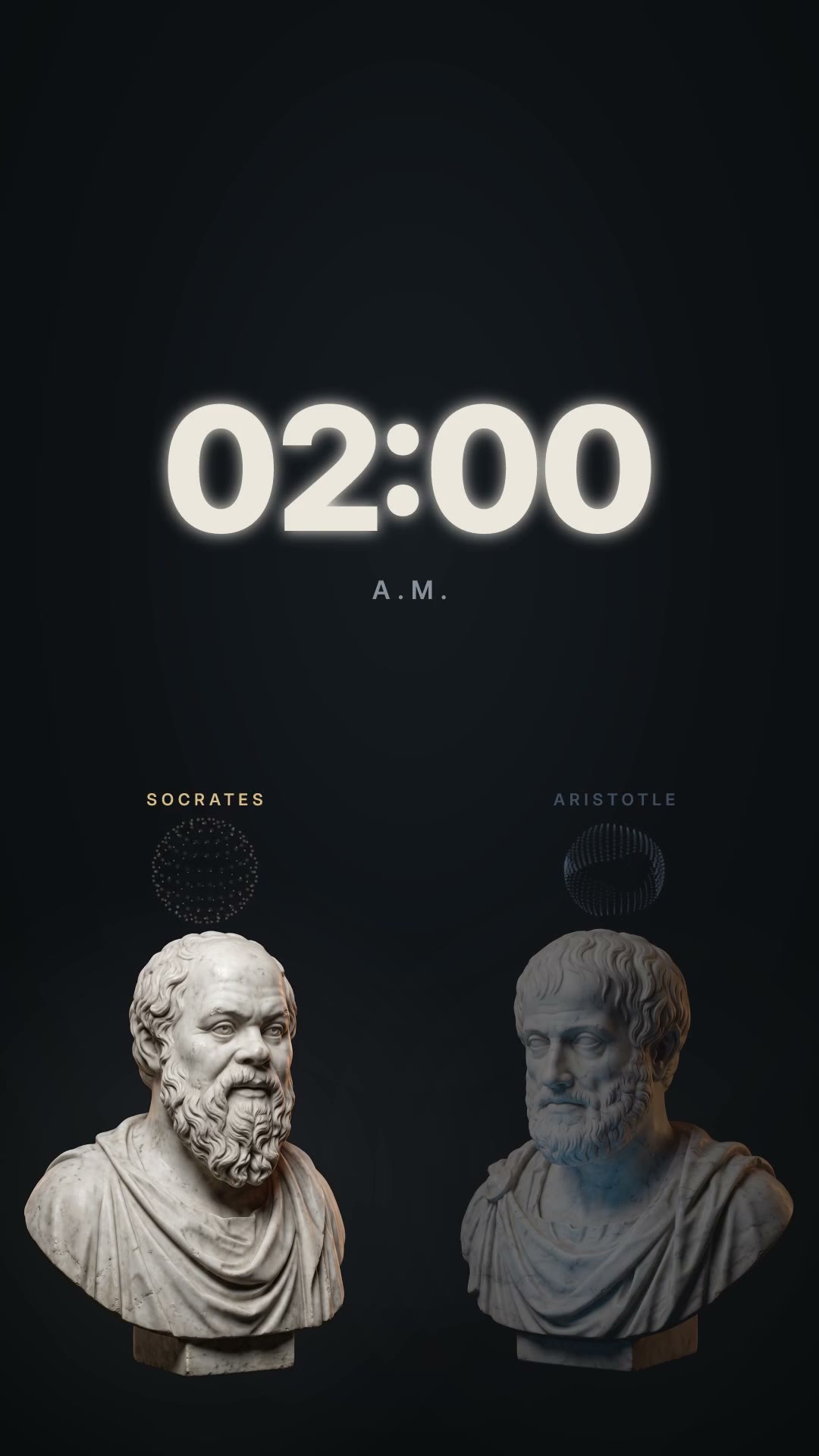
Socrates
Older, warm, sly, unhurried. Asks.
- Lines
- 9
- Questions
- 6
- Words
- 72
Aristotle
Middle-aged, brisk, slightly pompous, defensive. Builds systems.
- Lines
- 11
- Questions
- 1
- Words
- 86
- Socrates · 0.2 s Aristotle. It's two a.m. Why are you still scrolling?
- Aristotle · 5.2 s Research.
- Socrates · 5.7 s On what?
- Aristotle · 7.0 s Raccoons who are bad at stealing.
- Socrates · 9.7 s Ah. And what are you looking for?
- Aristotle · 12.3 s Nothing! I'm relaxing.
- Socrates · 14.4 s So you're working very hard... at relaxing. And you feel?
- Aristotle · 19.3 s Terrible. Thank you.
- Socrates · 21.1 s Then tell me. Is the phone serving you... or are you serving the phone?
- Aristotle · 27.4 s Okay, stop with the questions. This is why they gave you hemlock.
- Aristotle · 32.2 s Look. The problem isn't the phone. It's the dose. Zero screen time? Hermit. Infinite screen time? Raccoon. Virtue lives in the middle. The golden mean.
- Socrates · 44.3 s And where is the middle... at two in the morning?
- Aristotle · 47.4 s Asleep. The middle is asleep.
- Aristotle · 50.8 s Excellence is not an act, it's a habit. We are what we repeatedly do. Fact check · Widely quoted as Aristotle, but written by Will Durant in The Story of Philosophy (1926), summarising Aristotle's Ethics.
- Socrates · 56.6 s Lovely. Will Durant wrote that. In nineteen twenty-six.
- Aristotle · 61.0 s It's the vibe of my work!
- Socrates · 63.3 s The unexamined scroll is not worth scrolling.
- Aristotle · 67.0 s Put that on a mug.
- Socrates · 68.6 s I don't write things down.
- Aristotle · 70.9 s Fine. I'll post it for you.
Read Socrates alone and he speaks mostly in questions until he has the facts; read Aristotle alone and he answers, defends and builds a system (the golden mean, a quotation) until it collapses. The humour comes from each man’s real method, so neither needs a catchphrase. The lines are short where the pressure is high (“Research.” “On what?”) and long where Aristotle lectures. And every reply responds to the line before it: the scene can’t be reordered.
When a longer dialogue feels inconsistent, do exactly what the switch does: read each character’s lines together, and look for borrowed vocabulary, a change of register with no cause, or a line that contradicts the character’s motive.
Ground every claim. Aristotle’s line in the scene, “Excellence is not an act, it’s a habit. We are what we repeatedly do”, is usually credited to Aristotle, but the words are Will Durant’s, from The Story of Philosophy (1926), summarising Aristotle’s Ethics. The script checked the source and turned the correction into the scene’s payoff. Read the actual source before attributing a quotation, verify names, dates and numbers, and check what a number counts: a share of messages is not a share of people.
5. How many words is a 60-second script?
About 150 to 175 for one narrator at a natural pace, fewer for dialogue, and less once the script needs silent action, reactions or on-screen text to read. Treat any word count as an estimate: the real length comes from a reading in the actual language and delivery. Paste your script below, or set the pace from a measured take:
Estimated length
0:54
An estimate from a word count. A reading by the actual voice decides.
At this pace, a video of
- 15 s 38
- 30 s 75
- 60 s 150
- 90 s 225
Measured takes (click one to use its pace)
The same 136 words took between 47 and 53 seconds depending on the voice, a difference of six seconds in under a minute. The dialogue runs slower than any narrator because every answer waits for its question. Count the action too: a reveal followed by a reaction needs time for both, and speech over a demonstration can share the demonstration’s time.
When the script is too long, cut a repeated claim, an unnecessary example or a subplot first, or let a clear picture carry what the words explain twice. Don’t fix length by rushing the voice or squeezing out every pause: that destroys the reason for the passage. If the content can’t fit, the choice between scope and length belongs to the person who asked for the video.
6. Revise against what was actually made
Once something is recorded or generated, compare it with the script and update the script to match the take you chose. In Low Tide, the faces disappeared from the film and the project’s notes recorded why; the beats didn’t change, so the story didn’t either. When a speaker improvises, keep their actual words in the transcript, recheck any claim the improvisation added, and move any picture cue that depended on the words they changed. Writing a corrected sentence into the document doesn’t change the recording: ask for a pickup of the specific passage.
Revise the problem the feedback names. If a joke fails, look for its missing setup or response; if an explanation feels slow, look for repeated information or a demonstration arriving too late. Then check the setups, payoffs and continuity that the change touches elsewhere.
7. Prepare the script for its next use
Keep the spoken copy separate from staging and research notes, so a teleprompter never puts a production note in someone’s mouth. Keep performance tags out of the clean script and give them to the voice: the ElevenLabs voices guide covers casting and delivery. Keep enough scene labels for a later revision to find its passage. Then read it aloud at its intended pace, check that the opening pays off and that every speaker is clear, and give the essential action room to happen.